EBENEZER HALL
RALSTON STREET, AIRDRIE
20th Anniversary Celebration
A brief survey of the rise and progress of EBENEZER HALL from the year 1896 to the year 1979.
Written by Wm. McLachlan
To celebrate the 20th Anniversary of our new Hall in Ralston Street.
28th February, 1979
Early Beginnings
They met in the reading room of the Templars’ Hall, Quarry Street, Coatdyke, then in an “old iron church” long since demolished.
On the Main Street, skirting Locks Street, stood a building called “Cameron’s Land”, known locally as “wee hell”, for obvious reasons. The Fire Station now stands on this very site. A large room was rented in this notorious building, but with a bakery in the basement producing hot and questionable fumes, they had no success whatever. To add to an already odious atmosphere, foul language came from a number of youths outside, taking the Name of the Lord in vain, and while they were truly “knocked down” but not “knocked out”, they got up and went on.
A mission was arranged with two sisters from the Lanarkshire Christian Union, Miss Jack and Miss Cassells. Let me quote:
“Disappointed, we felt we should give up, but one lad was converted who created history for Coatdyke. After his own conversion he was the means of bringing the whole family to the Lord.”
That lad was bro. George McMaster, the uncle of David and Archie who are on full time service for the Lord. He emigrated shortly afterwards to South Africa. This was the turning of the tide. The struggle of these three years was but the birth pangs of a new day. It was the birth of a brilliant idea. What could this be?
Early Developments
Now for the idea: Could we not rent this place for a Gospel Hall? Eyebrows were raised, hopes ran high. Why not? Credit for this idea goes to bro. Alex Nisbet. No sooner said than done. Two young people, Alex. Nisbet and Bertha Jones, were delegated to consult Mr. Chapman, owner of the property. Struck with the sincerity of these young folk, he promised “should I not obtain a licence at the next term, I shall rent it to you for Gospel meetings!”.
The “band prayed” and the committee refused [the licence]. True to his word, the pub was “converted” and became known as Chapman’s Hall, the annual rent being £20. They now had a membership of 37. They were young and energetic and deeply devoted to the Lord. During 14 years in this hallowed place they laboured for the furtherance of the Gospel, the Spirit setting His seal on their efforts. Setbacks and disappointments assailed them but they “went on unto maturity”. These were but growing pains.
They also formed a male quintette—double bass, bass, baritone, first and second tenors—which, I am informed, was superlative. The five who formed this quintette were:
- W. Menzies
- R. White
- J. Currie
- Bob White
- J. McLachlan
Sorry, no recordings! A mixed choir was also formed and sang most acceptably every Sunday evening at the Gospel service. Then a male voice choir came into being and their services were in great demand.
Coatdyke Gospel Band Minutes
March 10th, 1913
Below is an extract from the minutes of 10th March, 1913:
“A card to be printed with the rules for the band. The name to be on front page, The Coatdyke Gospel Band, and then a little further down, instituted 5th February, 1896. Inside, the object of the Band.
The object: the advancement of God’s Kingdom in the ingathering of souls, together with the quickening of spiritual life in believers.
Then a little further down: Our basis of union. The divine inspiration, authority and sufficiency of the Word of God as revealed in the Old and New Testaments.
Then on third page the copy of rules.
- A person is not eligible for membership unless professedly ‘Born of God’.
- The business of the band to be conducted by a committee chosen annually from members of the band only, including President, Vice President, Secretary and Treasurer; five to form a quorum.
- Members applying for membership will have their names read over at the Friday evening meeting. A deputation will then be appointed to wait on such persons, and report at the next Friday evening meeting, when, if the report be satisfactory, they will be admitted.
- Any member may be expelled from the Band for persistent inconsistency.
- Any member leaving the Band is requested to inform the Secretary, stating his reasons for so doing.
- A general business meeting will be held once a year for the election of Office Bearers and the transaction of any other business.
Then on the fourth page it was agreed to have two texts from the Bible at the top, this text:
‘I beseech you therefore brethren, by the mercies of God, that you present your bodies a living sacrifice, holy, acceptable unto God, which is your reasonable service’
Romans 12 v1.
Then a little further down this text:
‘The fruit of the righteous is a tree of life, and he that winneth souls is wise’
Proverbs 11 v30.
Then a little further down: name of member, address and date of admission.”
Later Developments
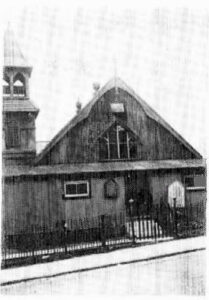
The church in Kippen Street, Airdrie
Later Developments
We move on towards the end of the year 1913 and Chapman’s Hall had served its day and generation. With the increase in numbers and expansion of the work, the hall became unsuitable. For two years the E. U. Congregational Church in Kippen Street had been vacant and was now up for sale. The committee approached the trustees who made a private agreement that they could buy the church for £85.
Their joy knew no bounds until it was discovered that there was a clause in the Title Deeds stating the church must be sold by auction. Deflation followed hard on the heels of elation, but their faith was strong. The day of the auction sale arrived and the committee was there to bid, while the women were praying in that well-known home, 21 Kippen Street. A local business man was interested in the building for other purposes and he was seen to cross the threshold of the room when the hammer crashed on the desk to the Coatdyke Gospel Band—yes, for £85!
A new chapter in their corporate life had opened. Some of the Old Testament incidents became alive with meaning, for the “sword and trowel” was the order of the day. With “operation cleaning” and “operation preaching”, the Word of the Lord had free course and was glorified. What better name than EBENEZER: “Hitherto has the Lord helped us”.
Every church had a belfry and a bell, and the new Ebenezer was no exception. “For whom the bell tolls”—but not for Ebenezer. A suggestion was made that the bell be taken down and sold. It was advertised but no buyers were forthcoming. Being disillusioned in the business world, they were more successful in the field of philanthropy, for the “Bell” was taken down and shipped to a missionary for use in Central Africa. So, even the “Bell” was put to evangelical service.
With the dawning of the year 1916, their thinking had turned towards the company known as Christian Brethren. Accordingly, their desires were made known to neighbouring assemblies. Meetings with these brethren were arranged and finally they were received “into the fold”. Announcement of this was made in the “Witness” and the Believers Magazine in April 1916.
Flexing their muscles, they plunged into gospel campaigns with noted evangelists. One such was John McAlpine of Troon. He came for a mission in November, 1920, and preached with such power that “revival times were on us”. I myself, as a lad, was introduced to Jesus as my Saviour during that time. The mission ran on for six weeks and would have continued but for the loss of voice suffered by Mr. McAlpine, and at least 70 people confessed Christ as Saviour. At the close of the mission 28 converts were baptised, publicly confessing their faith in Jesus Christ. This was a physical act of a spiritual fact—dead, buried and risen with Christ to live the New Life.
A report in the minutes showed a total of 116 members in 1921. Ladies and gents cloakrooms were built on to the front of the hall, extra room being required. Two outreaches were commenced, one in Carnbroe and the other in Glenboig. Children’s meetings were also held in Clarkston. These were very fruitful and continued for some years.
Membership had now risen to 246 in the year 1935, and while there were heart-breaking times, there were also soul-stirring events. The work of the Lord prospered and youth activities began to take shape. Many missions were arranged with well-known evangelists such as Wm. Hagan, Ed. Rankine, Jack Atkinson and Tom Richardson. These were most successful times when a great number were born into the Kingdom of God.
A most auspicious event happened in the year 1956. This was the Golden Wedding of Mr. & Mrs. James McLachlan. The Assembly took over arrangements and 500 people from every quarter sat down to a dinner in Airdrie Town Hall. A most memorable evening.
It has been our privilege to commend to the work of the Lord our sister (Mima Milln) Mrs. David Angus (Malaysia), bro. Tom Moses (Brazil), bro. Dan Cameron (evangelist), sister Margaret White (Zaire), bro. David McMaster (evangelist), bro. Sandy Anderson (France) and bro. Archie McMaster (evangelist).
Latest Development
The New Ebenezer Hall, Ralston Street
Latest Development
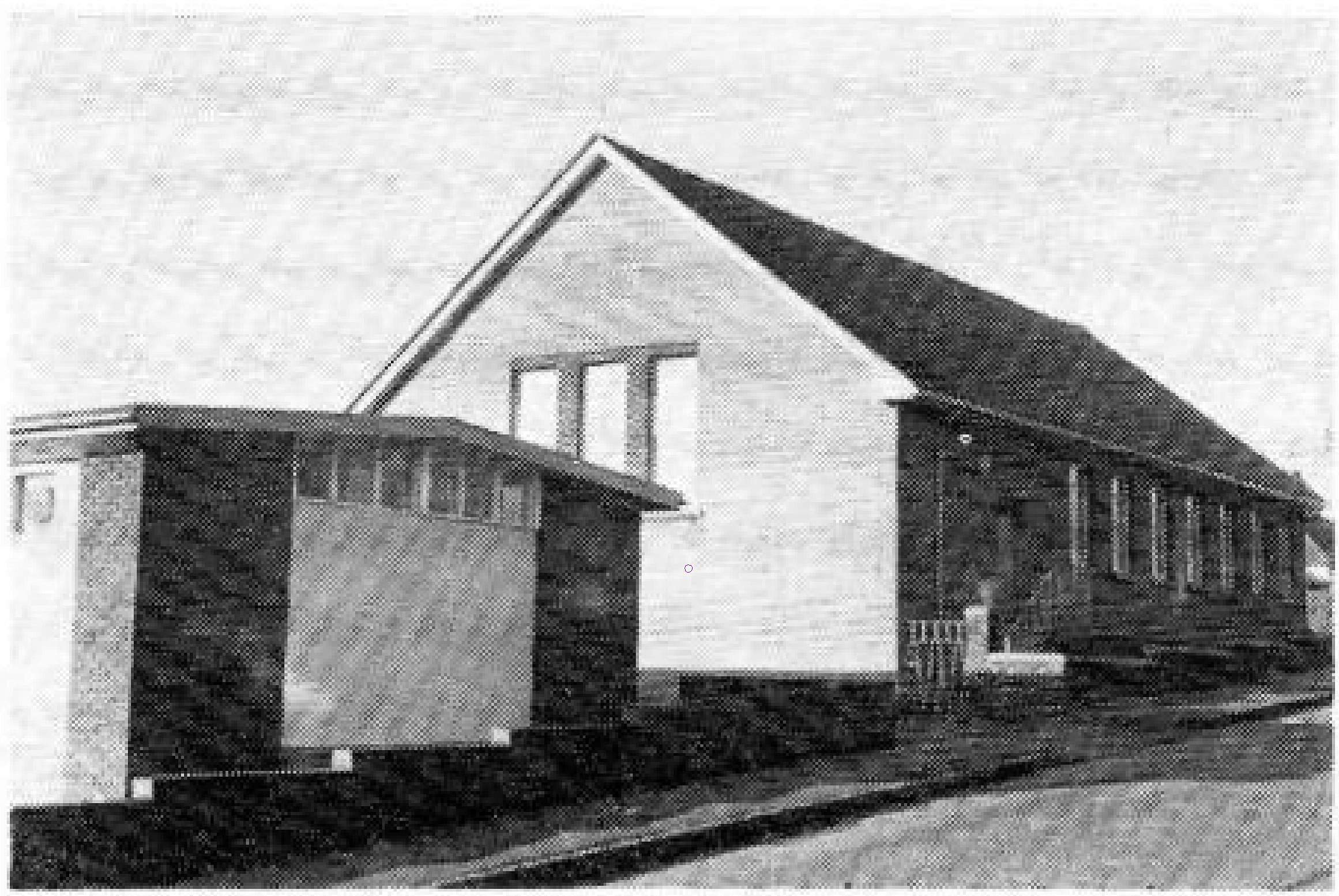
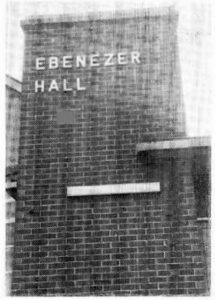 The old Ebenezer was literally bursting at the seams and the need for a new hall was evident. The present site was acquired in the Autumn of 1957. Plans were drawn up and work commenced in the Spring of 1958. This brought a fresh surge of enthusiasm and our hearts throbbed with great anticipation. The building was completed in February 1959 at the very modest sum of £10,640.
At the foundation stone ceremony, the foundation stone was laid by our much loved pastor, James McLachlan, who was presented with a silver trowel by bro. John Angus. A grand social heralded our entrance into the new hall, followed by a mission with Edwin Lewis of Stafford. These were times of great blessing to saint and sinner. We also had a mission with Robert Walker in October, 1963, at which Duncan Donaldson was saved. Hugh Davidson was the soloist.
Between the years of 1960 and 1970, houses in Ralston Street and Aitchison Street were demolished. This vacant ground was purchased. We were offered a semi-portable building (72′ x 24′) by the County of Lanark for £178, which was dismantled by ourselves, stored and rebuilt on the present site. The Youth Hall was completed by 1974 and this hall has proved a great benefit to our young people.
The plans for the main hall and youth hall were executed and supervised most efficiently by our bro. John Angus, Architect, to whom we owe a great debt. The total area of ground on which the buildings now stand extends to 5/8ths of an acre and assets at today’s figure are over £200,000.
Conclusion
“We have a great past, but that creates a great responsibility.”
‘To God be the Glory, Great things He hath done.’